 When first thinking about what to write in this post, I was wondering about what the most important thing is that Nietzsche has to offer to philosophy. And since pondering upon this thought I deduced, that, putting aside his key ideas such as; the Apollonian and Dionysian dichotomy, perspectivism, the Will to Power, the "death of God", the Übermensch and eternal recurrence, if there is anything that you should take away from this, at the very least it is that he had an epic moustache!
However, more importantly and more relevant to the synoptic unit I will be doing at the end of this year... I will be looking at his idea of the Übermensch and the death of God. Firstly though, something that I found quite interesting about Nietzsche, was what happened to him relatively early on in life. After resigning from being the Chair of Classical Philosophy at the University of Basel, his health problems rapidly escalated and he lost all mental faculties (which seemed to be due to a tertiary stage of syphilis), and due to this, his sister then cared for him. It then followed that because of this, for a long time, Nietzsche was seen to be very anti-Semitic, and even a kind of Nazi. All because of the fact that whilst under his sisters care, she reworked his unpublished writings to fit her husbands nationalist ideologies. Therefore this is why since then, many twentieth-century scholars have attempted to disprove these false allegations against Nietzsche.
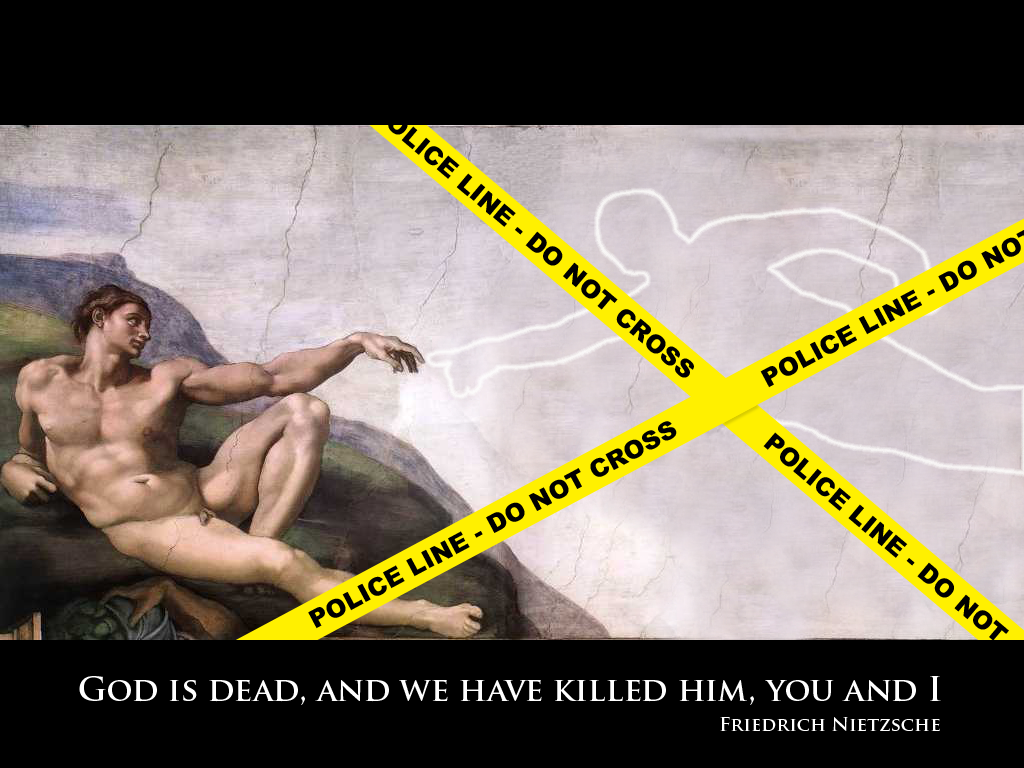
Now, moving onto the idea of the death of God. The term 'God is dead' has possibly become his most well known remark. The basis around this comment comes from an origin in Nihilism (which I guess is coming from the Latin word nihilo - nothing?) which basically argues that life is now existing without objective meaning, purpose or intrinsic value. And especially in terms of Nietzsche, Nihilism always has negative meanings and connotations. In addition to this, as he was a moral Nihilist, he stated that morality does not inherently exist, and anyone claiming to have any established morals has abstractly invented them, in order to feel as though they have truly gained them. The reason that this links in with the death of God, is due to how Nietzsche possibly felt that the secularisation of modern society, had 'murdered' the Abrahamic God, and left people with the feeling that life has no inherent importance or purpose. In fact, Nietzsche had his own definition and version of this which he called passive Nihilism. To achieve this idea of passive Nihilism, he worked from the basis of Schopenhauer's doctrine, which he describes as a kind of Western Buddhism. This incorporates the ascetic attitude which is a 'will to nothingness', that religions such as Buddhism and Jainism use, which again work upon the idea that there is nothing of value to be found in the world, which is why they have an abstinence towards many worldly pleasures.
 The other important concept to understand abouts Nietzsche's thoughts, is that of the Übermensch. The general translation of this, is that of a superman, or an overman. The Übermensch first appears in Nietzsche's book 'Thus Spoke Zarathustra', where the gift of the Übermensch is given to mankind as a way to solve the problem that faces it, even though they are not yet aware of the problem. In the book, it also presents the Übermensch as the creator of new values, and he appears as a solution to the problem of the death of God and also to nihilism. The reason that the Übermensch is above everyone else and different is because he/she does not follow the common morality of ordinary people and rises above the 'herd mentality' in order to judge for him/herself what the notion of good and evil really is. However, in order for the Übermensch to fulfil their greatest potential he/she must have a spiritual evolution in self awareness which for example, then enables them to overcome the traditional superstitions of deep rooted beliefs such as Christianity and any others that they hold in life. And so finally, Nietzsche then thinks that once the Übermensch has achieved these feats they must then accept our worldly experience as the greatest one available and possible, and then they will truly have satisfaction in their lives, as well as objective meaning. So, overall it might possibly be saving them from the death of God.


